
Interactive Place Value Arrows
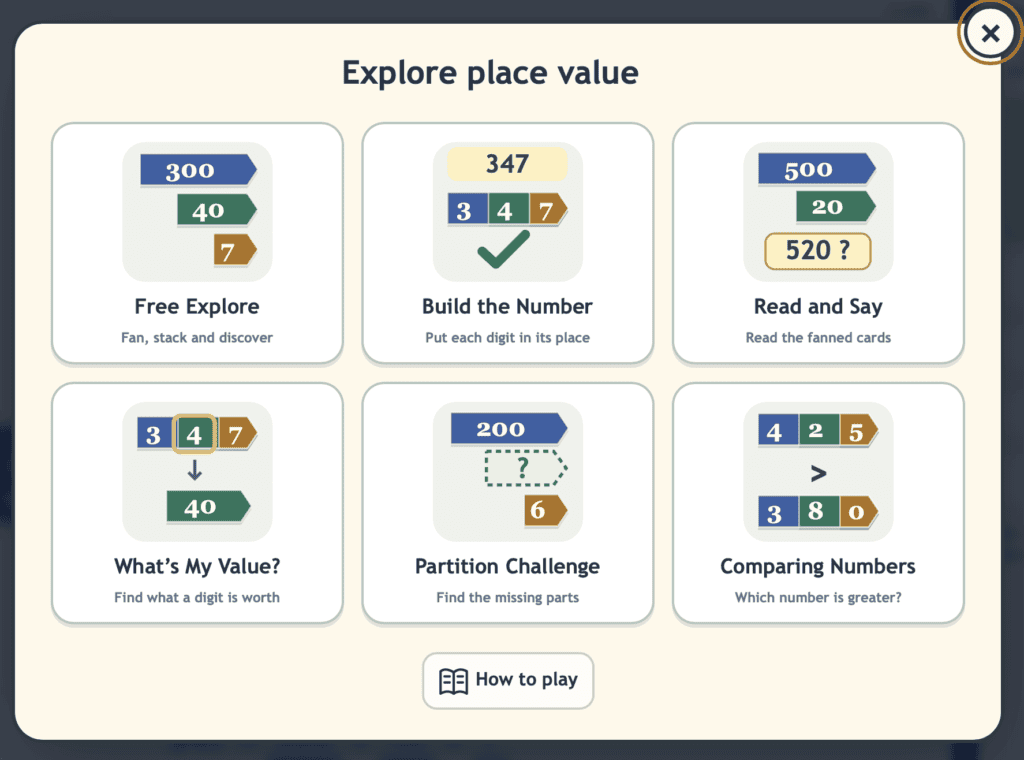
Explore place value in a clear, visual and hands-on way with our interactive Place Value Arrows tool, designed for the primary classroom. Children can build, combine and partition numbers using colourful place value arrows, helping them understand the value of each digit and how numbers are made up of thousands, hundreds, tens and ones. Perfect for whole-class demonstrations, independent exploration and mental maths activities, this engaging resource helps pupils develop a deeper understanding of our number system and build confidence when working with numbers.
Teacher Notes
Curriculum Links
This tool supports the Number strand of the Irish Primary Mathematics Curriculum, particularly Numeration and Counting and Place Value and Base Ten. It is most suitable for 1st – 4th Class, helping children develop an understanding of how numbers are composed, partitioned and represented within our base-ten number system. By combining place value arrows, pupils can explore the relationship between thousands, hundreds, tens and ones, recognise the value of individual digits and develop confidence when reading, writing and manipulating numbers.
Children can use Interactive Place Value Arrows to:
build and represent numbers, identify the value of digits, partition numbers into thousands, hundreds, tens and ones, explore expanded form, compose and decompose numbers, understand the base-ten system, compare number values, investigate zero as a placeholder, and strengthen mental calculation and number sense.
The resource is particularly well aligned with Stage 2 (1st–2nd Class) and Stage 3 (3rd–4th Class) of the curriculum. Curriculum Online – Place Value and Base Ten
Lesson Ideas
Build the Number
Call out a number and ask children to combine the correct place value arrows to represent it. Encourage them to explain the value of each digit.
Partition It
Display a number and challenge children to break it into thousands, hundreds, tens and ones. Discuss how each part contributes to the whole number.
What’s My Number?
Give clues such as “I have 3 thousands, 5 hundreds, 2 tens and 7 ones.” Ask children to build the mystery number using the arrows.
Change One Digit
Build a number, then replace one place value arrow with another. Ask children to predict how much the number will increase or decrease.
Expanded Form
Choose a number and ask pupils to write it in expanded form before using the arrows to check their answers. Explore how the individual values combine to make the whole number.
Related Tools
Check out some other interactive tools to help children with number sense.
Want More Visual Maths Tools?
Browse the full library of free interactive maths tools for primary classrooms.
